
Endocrinology & Diabetes
The landmark Endocrinology and Diabetes trials every internist should be able to quote — 29 trials across 5 evidence panels, each linked to its primary paper with a brief, plain-language summary of what it showed and why it changed practice.
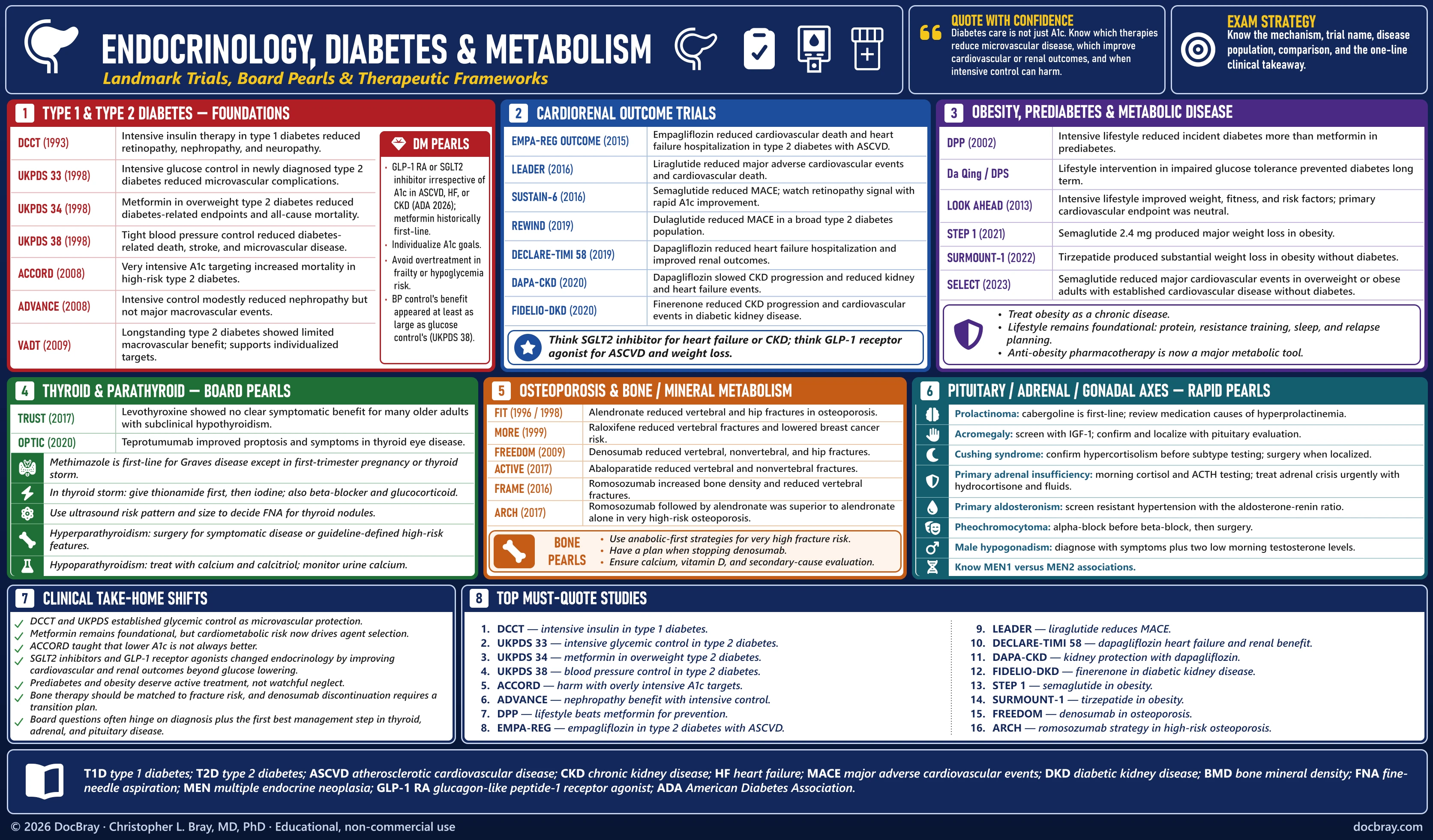
Panel 1 — Type 1 & Type 2 Diabetes: Foundations
- DCCT1993
Randomized trial of ~1,441 patients with type 1 diabetes comparing intensive insulin therapy (aiming for near-normal glucose) with conventional therapy. Intensive control reduced the risk of developing retinopathy by 76% in primary prevention, and also lowered progression of nephropathy and neuropathy, at the cost of a two- to threefold increase in severe hypoglycemia. DCCT established tight glycemic control as the foundation of microvascular protection in type 1 diabetes and, through the later EDIC follow-up, underpins the concept of metabolic memory.
DCCT Research Group (Nathan DM et al). N Engl J Med. 1993;329(14):977-986. PMID 8366922 → · DCCT/EDIC cardiovascular follow-up: Nathan DM et al. N Engl J Med. 2005;353(25):2643-2653. PMID 16371630 →
- UKPDS 331998
In newly diagnosed type 2 diabetes, intensive glucose control with sulfonylureas or insulin (median HbA1c 7.0% vs 7.9%) reduced any diabetes-related endpoint by ~12%, driven almost entirely by a ~25% reduction in microvascular complications (chiefly retinal photocoagulation). Macrovascular events were not significantly reduced. UKPDS 33 confirmed that better glycemic control prevents microvascular disease in type 2 diabetes and set the paradigm of glycemic control as primarily microvascular protection.
UK Prospective Diabetes Study (UKPDS) Group. Lancet. 1998;352(9131):837-853. PMID 9742976 →
- UKPDS 341998
Overweight patients with type 2 diabetes randomized to intensive control with metformin had significant reductions in any diabetes-related endpoint (~32%), diabetes-related death (~42%), and all-cause mortality (~36%) versus conventional therapy, with less weight gain and hypoglycemia than sulfonylurea/insulin. This trial made metformin the default first-line drug for type 2 diabetes for two decades, although the paper itself proposed it as first-line only for overweight patients, and ADA guidance now starts a GLP-1 receptor agonist and/or SGLT2 inhibitor with proven benefit, irrespective of A1c, when ASCVD, heart failure (an SGLT2 inhibitor), or CKD is present. In the 1998 analysis it was the only UKPDS agent to reduce macrovascular events and mortality; the 10-year post-trial follow-up later showed “legacy” reductions in myocardial infarction (15%) and all-cause death (13%) in the sulfonylurea/insulin group too, alongside metformin’s 33% and 27%. Exam distractor: early addition of metformin to sulfonylurea was associated with more diabetes-related deaths in a substudy, a signal the trial’s epidemiological analysis did not confirm.
UK Prospective Diabetes Study (UKPDS) Group. Lancet. 1998;352(9131):854-865. PMID 9742977 → · UKPDS 80, 10-year follow-up: Holman RR et al. N Engl J Med. 2008;359(15):1577-1589. PMID 18784090 → · ADA Standards of Care in Diabetes—2026, Section 9. Diabetes Care. 2026;49(Suppl 1):S183-S215 →
- UKPDS 381998
In hypertensive patients with type 2 diabetes, tight blood-pressure control (mean 144/82 vs 154/87 mmHg) reduced any diabetes-related endpoint by ~24%, diabetes-related death by ~32%, stroke by ~44%, and microvascular disease by ~37%. The benefit of BP lowering appeared at least as large as that of glucose lowering, cementing aggressive blood-pressure management as a core pillar of diabetes care.
UK Prospective Diabetes Study Group. BMJ. 1998;317(7160):703-713. PMID 9732337 →
- ACCORD2008
In ~10,000 high-cardiovascular-risk type 2 patients, targeting HbA1c <6.0% versus 7.0–7.9% did not reduce major cardiovascular events and unexpectedly increased all-cause mortality (HR 1.22), prompting early termination of the intensive arm. ACCORD is the landmark cautionary trial showing that overly intensive glycemic targets can be harmful in high-risk patients with established type 2 diabetes, and it drives individualized, less aggressive A1c goals.
ACCORD Study Group (Gerstein HC et al). N Engl J Med. 2008;358(24):2545-2559. PMID 18539917 →
- ADVANCE2008
Intensive glucose control (gliclazide-based, target HbA1c ≤6.5%) in type 2 diabetes reduced the combined micro/macrovascular endpoint by ~10%, driven by a ~21% reduction in nephropathy, with no significant effect on major macrovascular events or mortality. Unlike ACCORD, ADVANCE showed no excess mortality. Together with ACCORD and VADT it established that intensive control yields modest renal/microvascular benefit but not clear macrovascular gain.
ADVANCE Collaborative Group (Patel A et al). N Engl J Med. 2008;358(24):2560-2572. PMID 18539916 →
- VADT2009
In ~1,791 veterans with longstanding, poorly controlled type 2 diabetes, intensive glucose control (median HbA1c 6.9% vs 8.4%) did not significantly reduce major cardiovascular events or mortality over ~5.6 years. A neutral trial reinforcing that in patients with advanced, longstanding diabetes, intensive glycemic control offers limited macrovascular benefit and supporting individualized rather than uniformly aggressive targets.
Duckworth W et al (VADT Investigators). N Engl J Med. 2009;360(2):129-139. PMID 19092145 →
Panel 2 — Cardiorenal Outcome Trials
- EMPA-REG OUTCOME2015
In type 2 diabetes with established atherosclerotic cardiovascular disease, the SGLT2 inhibitor empagliflozin reduced the primary 3-point MACE by ~14%, cardiovascular death by ~38%, all-cause mortality by ~32%, and hospitalization for heart failure by ~35% versus placebo. The first of the modern placebo-controlled cardiovascular outcome trials to show that a glucose-lowering drug reduces cardiovascular death, launching SGLT2 inhibitors as cardioprotective agents.
Zinman B et al. N Engl J Med. 2015;373(22):2117-2128. PMID 26378978 →
- LEADER2016
In type 2 diabetes at high cardiovascular risk, the GLP-1 receptor agonist liraglutide reduced 3-point MACE by ~13% and cardiovascular death by ~22% versus placebo over 3.8 years. LEADER established GLP-1 receptor agonists as a second class of glucose-lowering drugs with proven atherosclerotic cardiovascular benefit.
Marso SP et al (LEADER Steering Committee). N Engl J Med. 2016;375(4):311-322. PMID 27295427 →
- SUSTAIN-62016
Subcutaneous semaglutide lowered 3-point MACE by ~26% (HR 0.74; the trial was designed to test noninferiority) versus placebo in high-risk type 2 diabetes, with the largest effect on nonfatal stroke. The caution: retinopathy complications were significantly more frequent with semaglutide (HR 1.76). A later analysis of the trial attributed this to the size and speed of HbA1c reduction, concentrated in insulin-treated patients with pre-existing retinopathy and poor baseline control — the board-relevant "watch the retinopathy signal" caveat.
Marso SP et al. N Engl J Med. 2016;375(19):1834-1844. PMID 27633186 → · Retinopathy analysis: Vilsbøll T et al. Diabetes Obes Metab. 2018;20(4):889-897. PMID 29178519 →
- REWIND2019
Weekly dulaglutide reduced MACE by ~12% versus placebo in a broad type 2 diabetes population in which only 31% had prior cardiovascular disease (most enrolled on risk factors alone). REWIND extended GLP-1 receptor agonist cardiovascular evidence beyond secondary-prevention populations; the authors concluded dulaglutide could be considered in people with either previous cardiovascular disease or cardiovascular risk factors.
Gerstein HC et al (REWIND Investigators). Lancet. 2019;394(10193):121-130. PMID 31189511 → · Baseline characteristics: Gerstein HC et al. Diabetes Obes Metab. 2018;20(1):42-49. PMID 28573765 →
- DECLARE-TIMI 582019
In a broad type 2 diabetes population (majority primary prevention), dapagliflozin did not significantly reduce MACE (met noninferiority) but did reduce the co-primary composite of cardiovascular death or heart-failure hospitalization by ~17%, driven by fewer heart-failure hospitalizations, with a favorable renal signal. Neutral for atherosclerotic events but confirming the SGLT2-inhibitor heart-failure and renal benefit even in lower-risk patients.
Wiviott SD et al. N Engl J Med. 2019;380(4):347-357. PMID 30415602 →
- DAPA-CKD2020
In chronic kidney disease with or without diabetes, dapagliflozin reduced the primary composite of sustained eGFR decline ≥50%, end-stage kidney disease, or renal/cardiovascular death by ~39%, and lowered all-cause mortality. Extended SGLT2-inhibitor renal protection to non-diabetic CKD, making these drugs foundational disease-modifying therapy for proteinuric kidney disease.
- FIDELIO-DKD2020
The nonsteroidal mineralocorticoid-receptor antagonist finerenone reduced a composite kidney outcome (kidney failure, sustained ≥40% eGFR decline, renal death) by ~18% and a secondary cardiovascular composite by ~14% in diabetic kidney disease already on maximized RAS blockade. Hyperkalemia was more frequent. FIDELIO established finerenone as a distinct cardiorenal-protective option in diabetic kidney disease.
Bakris GL et al (FIDELIO-DKD Investigators). N Engl J Med. 2020;383(23):2219-2229. PMID 33264825 →
Panel 3 — Obesity, Prediabetes & Metabolic Disease
- DPP — Diabetes Prevention Program2002
In adults with impaired glucose tolerance, intensive lifestyle intervention (≥7% weight loss, ≥150 min/week activity) reduced incident type 2 diabetes by 58%, while metformin reduced it by 31% — lifestyle clearly outperformed metformin. The defining prevention trial: lifestyle beats metformin for delaying progression from prediabetes to diabetes.
- Da Qing / DPSDiabetes Prevention Studies
Two lifestyle-prevention trials in impaired glucose tolerance. Da Qing (China) randomized 33 clinics to diet and/or exercise and showed ~31–46% lower diabetes incidence over 6 years; its 30-year follow-up showed a median 3.96-year delay in diabetes onset and fewer cardiovascular events (HR 0.74), cardiovascular deaths (HR 0.67), and all-cause deaths (HR 0.74). The Finnish DPS showed intensive diet-and-exercise counseling cut progression to diabetes by 58% over a mean 3.2 years, a result the DPP matched a year later. Together they establish that lifestyle intervention in prediabetes prevents diabetes and the benefit persists for years.
Pan XR et al. The Da Qing IGT and Diabetes Study. Diabetes Care. 1997;20(4):537-544. PMID 9096977 → · Da Qing 30-year follow-up: Gong Q et al. Lancet Diabetes Endocrinol. 2019;7(6):452-461. PMID 31036503 → · Tuomilehto J et al (Finnish Diabetes Prevention Study Group). N Engl J Med. 2001;344(18):1343-1350. PMID 11333990 →
- LOOK AHEAD2013
In overweight/obese adults with type 2 diabetes, an intensive lifestyle intervention produced greater weight loss and improved fitness and cardiovascular risk factors but did NOT reduce the primary cardiovascular endpoint versus diabetes support/education; the trial was stopped early for futility. A key neutral result: intentional weight loss via lifestyle improves risk factors and fitness but did not lower cardiovascular events in this population.
Look AHEAD Research Group (Wing RR et al). N Engl J Med. 2013;369(2):145-154. PMID 23796131 →
- STEP 12021
In adults with overweight or obesity without diabetes, once-weekly semaglutide 2.4 mg plus lifestyle produced ~14.9% mean body-weight loss versus ~2.4% with placebo over 68 weeks. STEP 1 established GLP-1 receptor agonists as a major, clinically meaningful pharmacologic tool for obesity.
Wilding JPH et al (STEP 1 Study Group). N Engl J Med. 2021;384(11):989-1002. PMID 33567185 →
- SURMOUNT-12022
In adults with obesity (without diabetes), the dual GIP/GLP-1 receptor agonist tirzepatide produced dose-dependent weight loss up to ~20.9% at the 15 mg dose over 72 weeks versus ~3.1% with placebo. SURMOUNT-1 demonstrated tirzepatide's substantial, near-bariatric-range weight reduction, advancing incretin-based obesity therapy.
Jastreboff AM et al (SURMOUNT-1 Investigators). N Engl J Med. 2022;387(3):205-216. PMID 35658024 →
- SELECT2023
In adults with overweight/obesity and established cardiovascular disease but WITHOUT diabetes, once-weekly semaglutide 2.4 mg reduced the primary MACE composite by ~20% versus placebo over ~40 months. The first trial to show an anti-obesity/GLP-1 agent reduces cardiovascular events independent of diabetes, redefining obesity as a treatable cardiovascular risk factor.
Lincoff AM et al (SELECT Trial Investigators). N Engl J Med. 2023;389(24):2221-2232. PMID 37952131 →
Panel 4 — Thyroid & Parathyroid: Board Pearls
- TRUST2017
Randomized placebo-controlled trial of levothyroxine in older adults (≥65) with persistent subclinical hypothyroidism. Levothyroxine normalized TSH but produced no benefit in hypothyroid symptoms or tiredness scores versus placebo. A neutral trial supporting a conservative, watchful approach and cautioning against routine levothyroxine for mild subclinical hypothyroidism in older adults.
Stott DJ et al (TRUST Study Group). N Engl J Med. 2017;376(26):2534-2544. PMID 28402245 →
- OPTIC2020
In active thyroid eye disease (Graves orbitopathy), the anti-IGF-1-receptor monoclonal antibody teprotumumab significantly improved proptosis (~83% vs 10% had ≥2 mm reduction) and diplopia versus placebo over 24 weeks. OPTIC, the confirmatory phase 3 after a 2017 randomized trial (69% vs 20% responders), led to teprotumumab’s FDA approval on January 21, 2020, as the first drug approved for thyroid eye disease. Board-relevant caveats from the label: hyperglycemia (10% vs 1%) and hearing impairment (10% vs 0 in the premarketing trials, 19% in two later trials), with a warning that hearing loss may be permanent.
Douglas RS et al. N Engl J Med. 2020;382(4):341-352. PMID 31971679 → · Phase 2: Smith TJ et al. N Engl J Med. 2017;376(18):1748-1761. PMID 28467880 → · Drugs@FDA: Tepezza, BLA 761143 (approved 01/21/2020) → · Tepezza prescribing information (DailyMed, rev. 9/2026) →
Panel 5 — Osteoporosis & Bone / Mineral Metabolism
- FIT — Fracture Intervention Trial1996 / 1998
Two arms of the Fracture Intervention Trial testing alendronate. The 1996 Lancet arm, in women with prevalent vertebral fractures, showed alendronate roughly halved new vertebral fractures and reduced hip fractures by ~51%. The 1998 JAMA arm, in women with low bone density but no vertebral fracture, did not significantly reduce clinical fractures overall but cut them by 36% in women with osteoporosis-range femoral-neck density. Together FIT established bisphosphonate therapy as first-line for reducing vertebral and hip fractures in postmenopausal osteoporosis.
Black DM et al (Fracture Intervention Trial Research Group). Lancet. 1996;348(9041):1535-1541. PMID 8950879 → · Cummings SR et al (FIT Research Group). JAMA. 1998;280(24):2077-2082. PMID 9875874 →
- MORE1999
In postmenopausal women with osteoporosis, the selective estrogen-receptor modulator raloxifene reduced the risk of new vertebral fractures by ~30–50% over 3 years but did not significantly reduce non-vertebral or hip fractures. A widely cited secondary finding was a lower incidence of invasive breast cancer (RR 0.24), confined to ER-positive tumors, against a threefold increase in venous thromboembolism (RR 3.1). Positions raloxifene as a vertebral-fracture and breast-risk option rather than broad-spectrum fracture protection.
Ettinger B et al (MORE Investigators). JAMA. 1999;282(7):637-645. PMID 10517716 → · Breast cancer analysis: Cummings SR et al. JAMA. 1999;281(23):2189-2197. PMID 10376571 →
- FREEDOM2009
In postmenopausal women with osteoporosis, the RANK-ligand inhibitor denosumab (60 mg SC every 6 months) reduced new vertebral fractures by ~68%, hip fractures by ~40%, and non-vertebral fractures by ~20% over 3 years versus placebo. FREEDOM established denosumab as a potent broad-spectrum antiresorptive; board-relevant caveat: in a post hoc analysis of FREEDOM and its extension, vertebral fractures rose from 1.2 to 7.1 per 100 participant-years after denosumab was stopped, often as multiple fractures, so discontinuation requires a transition plan.
Cummings SR et al (FREEDOM Trial). N Engl J Med. 2009;361(8):756-765. PMID 19671655 → · Discontinuation analysis: Cummings SR et al. J Bone Miner Res. 2018;33(2):190-198. PMID 29105841 →
- ACTIVE2016
In postmenopausal women at high fracture risk, the PTH-related-protein analog abaloparatide reduced new vertebral fractures by 86% (0.6% vs 4.2%) and nonvertebral fractures by 43% (2.7% vs 4.7%) versus placebo over 18 months. An open-label teriparatide arm showed a similar vertebral-fracture reduction (the trial was not designed to compare the two), and hypercalcemia was less frequent with abaloparatide (3.4% vs 6.4%). ACTIVE established abaloparatide as an anabolic (bone-forming) option for high-risk osteoporosis.
Miller PD et al. JAMA. 2016;316(7):722-733. PMID 27533157 → · Fracture rates: Tymlos prescribing information, 2017, section 14 (FDA) →
- FRAME2016
In postmenopausal osteoporosis, the sclerostin inhibitor romosozumab (monthly for 12 months, then denosumab) reduced new vertebral fractures by ~73% versus placebo at 12 months, with continued benefit after transition to denosumab (0.6% vs 2.5% at 24 months) and a 12.7% greater lumbar-spine bone mineral density gain than placebo at 12 months. FRAME introduced romosozumab as a dual-action (bone-forming and antiresorptive) anabolic agent.
Cosman F et al. N Engl J Med. 2016;375(16):1532-1543. PMID 27641143 → · BMD: Evenity prescribing information, section 14 (DailyMed) →
- ARCH2017
In postmenopausal women with osteoporosis and prior fracture (very high risk), 12 months of romosozumab followed by alendronate reduced new vertebral fractures by ~48% and clinical/hip fractures versus alendronate alone. A cardiovascular safety signal (serious cardiovascular adverse events 2.5% vs 1.9% in year 1) was observed; the Evenity label now carries a boxed warning for myocardial infarction, stroke, and cardiovascular death. ARCH supports an anabolic-first ("romosozumab then antiresorptive") strategy for very-high-risk osteoporosis, with cardiovascular caution.
Saag KG et al (ARCH Study Group). N Engl J Med. 2017;377(15):1417-1427. PMID 28892457 → · Evenity prescribing information, boxed warning (DailyMed) →
Preparing for boards, teaching residents, or building your own trial file? Dr. Bray mentors trainees and early-career physicians at no cost.
Get in touch →